The 4.0- to 5.0-tonne electric forklift range targets demanding industrial applications with improved hydraulic performance, operator visibility and optional AI-assisted pedestrian detection.
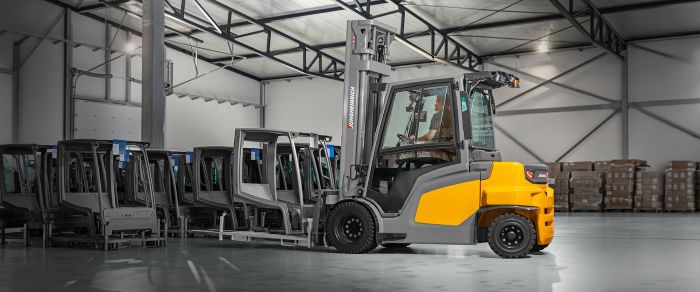
Jungheinrich has opened orders for its new-generation EFG 5 electric counterbalance forklifts, bringing a heavy-duty model range designed to compete with internal combustion trucks into commercial availability. Customers have been able to order the new trucks since November 1, 2026, following their introduction earlier this year. The EFG 5 series offers lifting capacities from 4.0 to 5.0 tonnes, with load centres of 500 or 600 mm and maximum lift heights of 7.5 metres.
The German equipment manufacturer is targeting intensive material-handling applications in sectors such as building materials, beverages, automotive manufacturing and general industry. These operations have traditionally relied heavily on diesel or other internal combustion forklifts, particularly where high loads, frequent lifting cycles and multi-shift operations demand consistent equipment performance.
“With the new EFG 5, we offer our customers a fully electric solution for applications that have often been dominated by diesel forklifts up to now. The vehicle combines high handling performance with high reliability and is consistently designed for heavy and intensive applications,” said Phillipp Brandl, Product Manager at Jungheinrich.
Higher Throughput and Hydraulic Performance
Jungheinrich says the new EFG 5 can deliver up to 15% higher handling performance through redesigned drive and hydraulic systems. The trucks use two high-torque traction motors, allowing travel speeds of up to 20 km/h, including under heavy loads. A new Synchronous Reluctance Lift Motor Plus (SRM+) is designed to accelerate lifting and lowering operations while maintaining energy efficiency.
Another important change concerns hydraulic performance. Jungheinrich reports approximately 50% greater hydraulic oil flow, enabling faster and more precise operation of attachments. This improvement is particularly relevant for applications involving large clamps and other hydraulic attachments that require substantial flow to operate efficiently.
Customers can choose between two performance configurations. The efficiencyPLUS version emphasizes energy-efficient operation at consistent performance levels, while drive&liftPLUS prioritizes acceleration, travel speed and faster lifting cycles. The company has not disclosed the specific test conditions behind its 15% throughput improvement claim, making it difficult to assess how closely that figure might translate to individual operating environments.
Improved Visibility and Operator Comfort
The redesign also addresses operator fatigue and visibility, two important considerations for forklifts working long shifts in busy industrial environments. The EFG 5 provides approximately 5% more foot space, revised pedal positioning and several seating options, including premium air-suspension seats. A cab isolated from the chassis is intended to reduce vibration and noise reaching the operator.
Visibility improvements include B-pillars that are approximately 30% slimmer, glass doors and an unobstructed panoramic roof window available from the ECO 1 cab configuration upward. These changes are intended to make it easier for operators to monitor their surroundings and maintain sightlines when placing loads at height.
AI-Assisted Pedestrian Detection Available
The EFG 5 also offers several optional assistance systems intended to support safer operation in industrial and warehouse environments. Available functions include Jungheinrich’s curveCONTROL, driveCONTROL, liftCONTROL and zoneCONTROL technologies, which help regulate truck behaviour under different operating conditions.
An optional addedVIEW camera system uses AI-supported person recognition to monitor the truck’s surroundings. When the system identifies a potential hazard, it provides visual and audible warnings and can automatically reduce travel speed. The technology is intended to supplement operator awareness, particularly in environments where pedestrians and forklifts frequently share operating space.
“Safety is a key productivity factor, especially in heavy-duty and intensive applications. The EFG 5’s assistance systems noticeably reduce the strain on the driver while increasing process reliability in the warehouse and on the company premises,” explained Brandl.
Battery Options for Different Applications
Jungheinrich is offering the new series with both lithium-ion and lead-acid batteries in different capacities, allowing customers to select energy systems suited to their operating schedules and charging infrastructure. Additional configuration options include several cab and equipment packages, provisions for demanding outdoor conditions, USB connections and an optional sound module.
The November sales launch follows Jungheinrich’s initial announcement of the EFG 5 in February 2026. With orders now open, the manufacturer is expanding the availability of electric forklifts in a capacity range where internal combustion equipment continues to play a significant role.
Actual operating costs, charging requirements and productivity benefits will depend on individual applications, particularly the intensity of truck use, attachment requirements and available charging opportunities.
Related Articles
Jungheinrich Opens Sales of EAC 212a Autonomous Pallet-Handling Robot
Jungheinrich and Kuehne+Nagel Sign Framework Agreement Covering 5,000 Industrial Trucks



