New forklift prices range from a few thousand dollars for basic powered pallet handling equipment to well over $100,000 for heavy-duty and specialized machines. Here’s what buyers can expect to pay for common forklift types and the factors that influence the final purchase price.
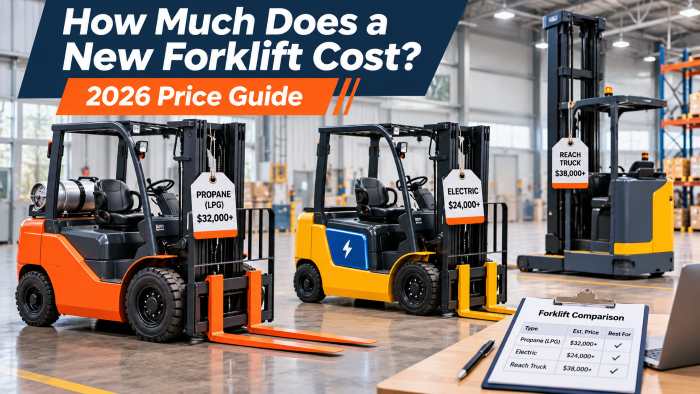
A new forklift typically costs between $25,000 and $50,000 for a common 5,000-pound capacity counterbalance model, although smaller, basic trucks may cost less and specialized equipment can be substantially more expensive. Electric, propane and diesel forklifts occupy overlapping price ranges, with the final cost determined by lifting capacity, mast configuration, battery or engine technology, attachments and manufacturer.
The 5,000-pound counterbalance forklift provides a useful starting point because it is widely used in warehouses, manufacturing plants and distribution facilities. However, the price of a forklift intended for loading trailers cannot be compared directly with that of a reach truck designed for 35-foot warehouse racking or a heavy-duty machine working in an outdoor lumber yard.
Published equipment listings and dealer guides provide a general indication of the market, but they are not a substitute for a quotation based on the specific application. Prices can vary considerably between manufacturers, dealers and regions, particularly when batteries, chargers and other equipment are priced separately.
How Much Do Different Types of Forklifts Cost?
The following ranges provide an approximate starting point for buyers comparing new equipment in the United States in 2026. They represent broad market estimates rather than standardized manufacturer list prices.
| Forklift type | Indicative new price (USD) |
|---|---|
| Electric powered pallet jack | $2,000–$8,000 |
| Electric walkie stacker | $5,000–$20,000 |
| Propane counterbalance forklift | $20,000–$45,000 |
| Electric counterbalance forklift | $25,000–$55,000 |
| Diesel counterbalance forklift | $30,000–$60,000 |
| Electric reach truck | $30,000–$65,000 |
| Warehouse order picker | $20,000–$50,000 |
| Rough-terrain forklift | $40,000–$100,000+ |
| Heavy-duty industrial forklift | $80,000–$200,000+ |
Indicative U.S. dollar ranges for 2026, compiled from published dealer pricing and industry guides. Equipment capacity, brand, configuration, battery and charger inclusion, delivery and regional market conditions can produce prices outside these ranges. Taxes, freight, and installation are generally additional unless stated otherwise.
Electric Forklift Prices
New electric counterbalance forklifts commonly fall in the $25,000-to-$55,000 range for standard warehouse applications, although larger and more specialized models can cost considerably more. The purchase price depends on rated capacity, mast configuration, tire type, battery technology and the equipment included with the truck.
Battery selection is especially important. Traditional lead-acid batteries may offer a lower initial equipment cost, while lithium-ion batteries can increase the purchase price but provide advantages in charging flexibility and maintenance. Some suppliers quote the battery and charger separately, making it essential to confirm exactly what is included before comparing offers.
Electric forklifts may have lower energy and routine maintenance costs than comparable internal combustion models, particularly when used regularly in indoor operations. However, the initial investment may also include charging infrastructure, electrical upgrades or changes to battery-handling arrangements.
Propane and Diesel Forklift Prices
New propane counterbalance forklifts typically cost approximately $20,000 to $45,000 for common warehouse and industrial capacities, with heavier models priced higher. They remain popular for loading docks, manufacturing facilities and operations that need equipment capable of moving between indoor and outdoor areas.
Diesel counterbalance forklifts generally begin around $30,000 for smaller industrial models and can become substantially more expensive as capacity increases. Larger diesel machines used in lumber, steel, construction and heavy manufacturing applications occupy a much broader price range than standard warehouse forklifts.
Internal combustion forklifts often have a lower initial cost than comparable electric trucks equipped with higher-cost battery systems. Their longer-term economics depend on fuel consumption, maintenance requirements, annual operating hours and the conditions in which they are used.
For a closer comparison, see Electric vs. Propane Forklifts: Which Is Better for Your Operation?.
What Factors Affect the Price of a New Forklift?
Lifting capacity is among the most important influences on purchase price. A forklift rated for 3,000 pounds generally costs less than a comparable machine rated for 8,000 pounds, since the heavier truck requires a more substantial structure, lifting system and other components. However, capacity alone does not explain every price difference. A specialized narrow-aisle truck with a relatively modest load rating may cost more than a larger general-purpose forklift because of its mast, controls and handling capabilities.
Lift height and mast configuration can also add substantially to the purchase price. A standard warehouse forklift with a two-stage mast may be less expensive than an otherwise similar truck equipped with a three-stage mast designed for high racking. Buyers also need to consider the truck’s collapsed mast height, particularly when it must pass through doorways, trailers or other restricted openings.
Attachments represent another potential expense. Sideshifters, fork positioners, clamps, rotators and specialized load-handling devices can increase acquisition costs while changing the forklift’s allowable lifting capacity. Tire configuration, operator comfort features, telematics and safety systems may also affect the quotation.
Brand and dealer support are less easily reduced to a simple price difference but should not be overlooked. Equipment with a lower purchase price may not represent better value if parts availability, technician support or warranty coverage is limited. Service response times can be particularly important in facilities where a forklift breakdown interrupts production or shipping.
Is a New Electric Forklift More Expensive Than Propane?
Electric forklifts often cost more initially than comparable propane models, particularly when lithium-ion batteries and charging equipment are included. However, the difference is not consistent across manufacturers or equipment configurations, and some electric models are competitively priced against internal combustion alternatives.
The more useful comparison is the total cost of ownership over the expected service life of the truck. Electric forklifts generally require less engine-related maintenance and may consume less expensive energy, while propane equipment offers rapid cylinder exchanges without the need for a dedicated charging system.
Annual operating hours make a significant difference. A forklift used intensively across multiple shifts has more opportunities to recover a higher purchase price through energy and maintenance savings. For equipment that operates only occasionally, minimizing the initial investment may be more important.
The cost of charging infrastructure can also alter the calculation. A warehouse that already operates electric forklifts may have sufficient capacity to accommodate additional units, while a facility converting from propane could face significant electrical installation costs.
What Additional Costs Should Buyers Budget For?
The purchase price on a forklift quotation may not represent the complete cost of putting the equipment into service. Freight, taxes, attachments, batteries, chargers and initial setup costs can add to the total, depending on the supplier and the equipment being purchased.
Electric forklift buyers should confirm whether the quotation includes the battery, charger and any required charging connections. They should also investigate whether the facility has sufficient electrical capacity to support the equipment’s operating schedule. For multi-shift fleets, the charging arrangement may be just as important as the specification of the forklift itself.
Maintenance and repair costs also belong in the purchasing calculation. Even new equipment requires scheduled inspections, lubrication, tire replacement and other service. Warranty terms, available service agreements and local parts support can influence the total expense of ownership.
Financing and leasing arrangements may reduce the initial cash requirement, but they introduce financing costs and contractual obligations that should be considered alongside the equipment price.
Should You Buy a New or Used Forklift?
Buying a used forklift can be an attractive alternative for businesses that need additional handling capacity without committing to the cost of new equipment. However, the price difference should be assessed against the truck’s age, operating hours, maintenance history and expected remaining service life.
A relatively inexpensive used forklift may require immediate attention to its tires, brakes, hydraulics or other components. Electric equipment also warrants a careful assessment of battery condition, particularly where an aging battery could create a major replacement expense.
New forklifts generally provide the advantages of manufacturer warranty coverage, current equipment specifications and the ability to configure a truck for the intended application. They may also be easier to integrate into a standardized fleet where maintenance procedures, operator training and replacement parts are already established.
For occasional use, a well-maintained used forklift may provide adequate service at a lower acquisition cost. In demanding, multi-shift operations, the reliability and support available with new equipment may justify the additional investment.
How Do You Get an Accurate Forklift Price?
The most useful starting point is a clear description of the work the forklift will perform. Dealers need to know the maximum load weight and dimensions, required lifting height, operating surface, aisle width, and expected daily operating hours. Indoor or outdoor use, power source preferences, and any specialized attachments should also be identified.
Providing these details allows suppliers to recommend equipment that meets the actual handling requirements rather than simply quoting a truck with a particular rated capacity.
When comparing quotations, buyers should confirm that each includes equivalent equipment and services. A lower price may reflect a smaller battery, shorter mast, different tire configuration, limited warranty or the exclusion of delivery and installation. Comparing complete specifications and delivered costs is more useful than comparing advertised starting prices.
For businesses buying several forklifts, it can also be worthwhile to evaluate how the proposed equipment fits the existing fleet. Standardizing equipment types, batteries and service arrangements may provide savings that are not immediately apparent in the purchase price.
Examples of Advertised New Forklift Prices
Published dealer listings provide a useful illustration of how forklift prices vary by capacity, power source and configuration. In November 2026, Valley Industrial Trucks advertised a new 5,000-pound CLARK S25 propane forklift for $33,959 and a 6,000-pound CLARK S30 for $35,550. Both were offered as part of the dealer’s new-equipment specials.
Electric models provide a different comparison. Forklift Consulting LLC advertised a new 2026 Hyundai 15BT-9U three-wheel electric forklift, rated for 3,000 pounds, at $42,989, while a 6,000-pound Hyundai 30B-X lithium-ion forklift was listed at $56,865. The same dealer advertised a 4,000-pound Hyundai 20BRP-X reach truck for $64,180.
At the heavier end of the market, a new Hyundai 70D diesel forklift with a 15,500-pound capacity was advertised at $125,000.
These are specific dealer asking prices rather than manufacturer-wide list prices or industry averages. They reflect particular equipment configurations and may change with inventory, optional features, freight, and other purchasing conditions. They nevertheless demonstrate why forklift buyers should compare complete specifications rather than relying on a single estimated price range.
The Bottom Line
A new 5,000-pound warehouse forklift commonly costs approximately $25,000 to $50,000 in the United States, while smaller pallet handling equipment can cost considerably less and specialized or heavy-duty forklifts can exceed $100,000.
The final price depends on more than lifting capacity. Power source, mast height, battery technology, attachments, operating conditions and dealer support all influence what a buyer ultimately pays.
The best purchasing decision starts with identifying the work the forklift must perform, then comparing equipment that meets those requirements. A lower purchase price may be attractive, but reliability, maintenance costs and operating efficiency will determine whether the forklift provides good value over its working life.



