Counterbalance forklifts and reach trucks both handle palletized loads, but their different designs make them better suited to different warehouse applications. Here’s how they compare in lifting capacity, aisle requirements, operating versatility and storage efficiency.
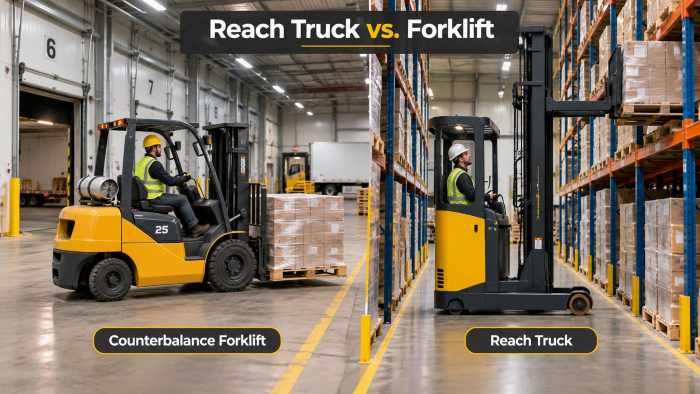
The most important difference between a conventional forklift and a reach truck is the way each handles pallet loads and the space it needs to operate. Counterbalance forklifts are versatile machines used for everything from loading trailers to moving materials around manufacturing plants and outdoor yards. Reach trucks, meanwhile, are designed primarily for narrow warehouse aisles and high-level pallet storage, where efficient use of floor space is a priority.
Strictly speaking, a reach truck is also a type of forklift. However, the distinction is well established in material handling operations, where the term forklift often refers specifically to a conventional counterbalance truck.
Reach trucks use a mechanism that extends the forks or mast forward to position pallets in storage racks, allowing the truck itself to remain within a relatively narrow aisle. A conventional counterbalance forklift typically needs more room to turn and position its load. This difference influences warehouse layout, storage density and the types of handling tasks each machine can perform efficiently.
Forklift vs. Reach Truck: Key Differences
| Feature | Counterbalance forklift | Reach truck |
|---|---|---|
| Primary application | General material handling, loading and unloading | Narrow-aisle pallet storage and retrieval |
| Typical aisle width | Approximately 12–14 feet | Approximately 8–10 feet |
| Load handling | Forks project forward from the mast | Forks or mast extend forward into racking |
| Stability | Uses a rear counterweight | Uses support legs and truck weight |
| Lift height | Varies widely by model and application | Designed for high-level storage, often 30 feet or more |
| Power | Electric, propane, diesel or gasoline | Primarily electric |
| Operating surface | Indoor or outdoor, depending on model | Generally smooth indoor floors |
| Best suited to | Versatile warehouse, dock and yard operations | High-density pallet storage |
Actual aisle requirements, lifting capacities and lift heights depend on the equipment model, load dimensions and warehouse configuration.
How Does a Counterbalance Forklift Work?
A conventional counterbalance forklift uses a heavy counterweight, usually located toward the rear of the truck, to help balance the load carried on its front-mounted forks. The forks travel vertically along a mast, allowing the operator to pick up pallets, transport materials and stack loads at different heights. The design is familiar throughout manufacturing plants, warehouses, distribution centres, loading docks and outdoor storage yards.
Versatility is the counterbalance forklift’s principal advantage. Depending on the model and configuration, the same machine may unload a trailer, move pallets across a facility and place loads into warehouse racking. Counterbalance forklifts are available with electric or internal combustion powertrains, several tire configurations and a broad range of lifting capacities. Models equipped for outdoor work can operate on surfaces that would be unsuitable for conventional reach trucks.
That flexibility comes with a trade-off in warehouse space. Because the forks and load project forward of the mast, the forklift generally needs sufficient room to turn into the aisle and approach a pallet position. The resulting aisle requirements can limit the amount of racking that fits into a warehouse, particularly when compared with equipment designed specifically for narrow-aisle storage.
How Does a Reach Truck Work?
Reach trucks address that space limitation through a different approach to load handling and stability. Most conventional designs use support legs extending forward from the truck rather than relying primarily on a large rear counterweight. The forks or mast can extend into the racking to deposit or retrieve a pallet, then retract to bring the load closer to the truck for travel.
Depending on the design, this movement may be accomplished through a pantograph mechanism that extends the fork carriage or a moving mast that travels forward along the truck’s support structure. Both approaches allow the truck to position loads in racking without requiring the same turning clearance as a conventional counterbalance forklift.
The combination of compact dimensions and a reach mechanism makes these trucks particularly useful in warehouses designed for high-density storage. Many reach trucks can work in aisles approximately eight to ten feet wide, while some models can lift loads more than 40 feet. These capabilities allow warehouse operators to increase storage density by reducing aisle space and making greater use of building height, provided the racking and floor are designed for the application.
Reach trucks are generally intended for smooth, level indoor surfaces. Their relatively small load wheels, limited ground clearance and specialized support structures make most conventional models poorly suited to rough yards or uneven outdoor pavement. They are therefore common in high-bay warehouses, distribution centres, cold storage facilities and other operations where pallet storage and retrieval account for a substantial share of forklift activity.
Which Can Lift More Weight, a Forklift or a Reach Truck?
Counterbalance forklifts are available in a considerably wider range of lifting capacities, from smaller warehouse models to specialized heavy-duty machines capable of lifting tens of thousands of pounds. Reach trucks generally concentrate on standard pallet loads, with many warehouse models rated in the 3,000-to-4,500-pound range, although higher-capacity versions are available.
The distinction becomes more important when loads must be placed at considerable heights. A reach truck may have different allowable capacities depending on the lifting height and load centre, while a counterbalance forklift’s capacity can also change with mast configuration, attachments and load positioning. Neither machine should be assumed capable of handling a particular pallet simply because its advertised capacity exceeds the load’s weight.
The manufacturer’s capacity plate provides the applicable lifting limits for each truck. For a broader explanation of rated capacity and load centre distance, see How Much Weight Can a Forklift Lift?.
Which Is Better for Your Warehouse?
The answer depends largely on the work the equipment must perform and the way the building is arranged. Where storage density is a priority, reach trucks can offer a considerable advantage. Narrower aisles create opportunities for additional racking, while greater lifting heights can increase the number of pallet positions available within the same building footprint. These benefits are particularly relevant in facilities where warehouse space is expensive or expansion options are limited.
Counterbalance forklifts make more sense when operations demand flexibility. A facility that regularly loads and unloads trailers, moves pallets over longer distances or handles materials in both indoor and outdoor areas may find a conventional forklift better suited to the workload. Reach trucks can perform some of these tasks under suitable conditions, but their design is optimized for working within storage aisles rather than serving as general-purpose material handling equipment.
There are also costs beyond the purchase price to consider. Introducing reach trucks may require changes to racking layouts, aisle dimensions, floor conditions and operator training. Conversely, the additional pallet capacity made possible by narrow-aisle storage can provide long-term value, particularly where available floor space is already under pressure. Equipment selection should therefore consider the entire handling system rather than the forklift’s specifications in isolation.
Many larger distribution centres use both types of equipment. Counterbalance forklifts handle receiving, shipping and general pallet movement, while reach trucks take care of storage and retrieval within narrow-aisle racking. This division of work allows each machine to operate where its design provides the greatest benefit.
Can a Forklift Operator Drive a Reach Truck?
Experience operating a conventional counterbalance forklift does not automatically qualify someone to operate a reach truck. Although both are powered industrial trucks, there can be significant differences in steering, controls, operator position, stability and load-handling procedures. Stand-up reach trucks, for example, require operators to become familiar with a driving position and steering behaviour that may be quite different from those of a sit-down counterbalance forklift.
Under OSHA’s powered industrial truck requirements, operators must receive training and evaluation appropriate to the type of truck they will operate. Employers must ensure that operators are competent to use the equipment assigned to them, including its particular controls and operating characteristics.
The Bottom Line
Counterbalance forklifts and reach trucks perform many of the same basic functions, but they serve different priorities. The counterbalance forklift offers versatility across loading docks, warehouses and outdoor handling areas, while the reach truck is designed to make more efficient use of warehouse space through narrower aisles and high-level pallet storage.
Where the main requirement is to move pallets between trucks, production areas and storage locations, a counterbalance forklift may be the more practical choice. In warehouses where maximizing pallet positions and efficiently servicing tall racking are the priorities, reach trucks often have the advantage. For many operations, the most effective solution is not choosing one over the other, but using both as complementary parts of the material handling system.



