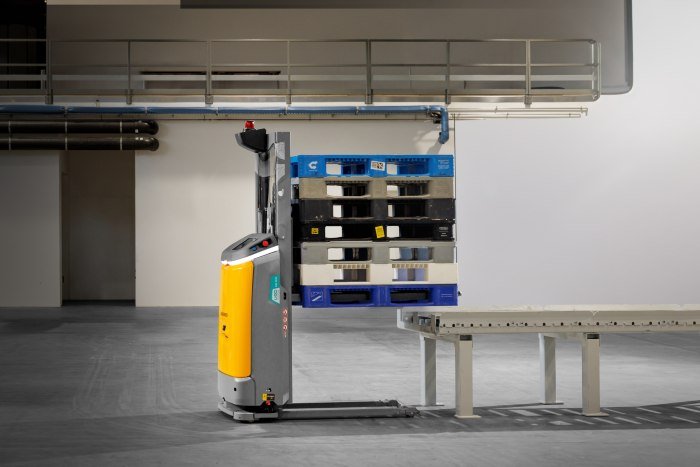
Jungheinrich has officially launched sales of its EAC 212a autonomous mobile robot, expanding its range of automated pallet-handling equipment. Introduced at LogiMAT 2026, the new machine is designed to move and lift palletized loads between receiving, storage, production and shipping operations.
The EAC 212a combines autonomous travel with an integrated lifting function, allowing it to connect different areas of a warehouse or manufacturing facility. Applications include moving pallets between floor storage locations, block storage areas, conveyor systems, automated storage and retrieval systems (AS/RS), and production or packaging lines.
According to Jungheinrich, the robot can be introduced into many existing facilities without extensive infrastructure modifications. This allows companies to begin automating a single material-handling route before expanding into additional applications.
Starting Small with Warehouse Automation
One of the selling points of the EAC 212a is its suitability for incremental automation. Rather than requiring a large-scale warehouse redesign, Jungheinrich says customers can start with one robot and add vehicles or connect additional processes as their requirements change.
The approach could appeal to operations that want to automate repetitive pallet movements but are not ready to commit to a comprehensive automated storage or material-handling installation.
Jungheinrich reports strong customer interest ahead of the official sales launch.
The EAC 212a also incorporates software capabilities developed for the company’s EAE 212a mobile robot. These include automated pallet storage and retrieval in block storage areas, management of pallet positions within storage lanes, and recovery functions designed to resolve certain interruptions without operator intervention.
The company’s automation platform is also being developed to support future Physical AI applications, including camera-based recognition of different load carriers.
Extending Autonomous Pallet Handling
At LogiMAT, Jungheinrich described the EAC 212a as suitable for handling pallets and mesh boxes at transfer heights of up to 1,200 mm. Its technology includes AI-supported 3D pallet detection and contour-based navigation, designed to support operation in existing warehouse environments, including those shared with manually operated equipment.
The sales launch adds another option for facilities considering automated pallet transport beyond conventional manually operated pallet trucks and stackers. Its integrated lifting capability allows the robot to serve transfer points at different heights, rather than simply transporting loads at floor level.
For warehouse operators, the practical questions will include installation requirements, reliability in mixed traffic, integration with existing systems and the cost of expanding from an initial application to a larger fleet.
Related Articles
Jungheinrich and Kuehne+Nagel Sign Framework Agreement Covering 5,000 Industrial Trucks
Jungheinrich Draws on Data From 30,000 Reach Trucks for New ETV 4i



